Sora 2
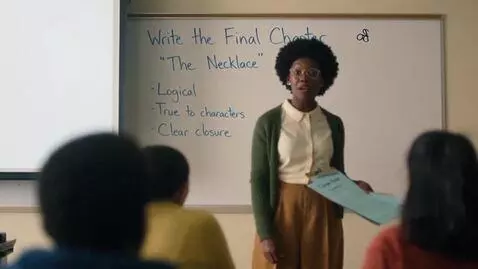
MICRO-TEACHING SCRIPT (Condensed) Lesson: Writing the Final Chapter of The Necklace Duration: 6–8 minutes Scene 1 – Transition Teacher: Excellent work, everyone! I really enjoyed your ideas from the Secret Letter activity. You gave thoughtful advice to Mathilde and used excellent vocabulary. Today, we're going to use those ideas to become authors. Today, you will write the final chapter of The Necklace. How does that sound? Students: Sounds interesting! Teacher: Great! Scene 2 – Introduce the Writing Task Teacher: Imagine that you are Guy de Maupassant, the author of The Necklace. Your task is to write the final chapter of the story. Remember three important rules: Your ending must be logical. It must stay true to the original story and characters. It should give the reader a clear sense of closure. CCQ Can Mathilde suddenly become a queen? Students: No. Teacher: Why not? Students: Because it doesn't fit the story. Teacher: Exactly! Everything in your ending should make sense. Can we suddenly introduce aliens? Students: No! Teacher: Correct. Your ending should always remain believable. Scene 3 – Explain the Prompt Teacher: (Read the prompt.) You may decide whether Mathilde solves her problem or not. There isn't only one correct ending, but every ending must be logical and meaningful. CCQ Does everyone have to write exactly the same ending? Students: No. Teacher: Exactly. Different endings are welcome if they fit the story. Scene 4 – Introduce the Planner Teacher: Before good writers begin writing, they organize their ideas. Today we'll use a Final Chapter Planner to help us plan before we write. Good writing starts with good planning. Scene 5 – Teacher Model (Think Aloud) Teacher: Let's complete the planner together. Opening First, I ask myself, "What happened last?" The story ends when Mathilde discovers the necklace was fake. My opening should connect to that moment. I'll write: "Mathilde stood silently after hearing the shocking truth about the necklace." Why is this a good opening? Because it connects directly to the original story. CCQ Should I begin by saying, "Mathilde became a famous singer"? Students: No. Teacher: Exactly. It doesn't fit the story. Development Now I ask, "What happens next?" Maybe Mathilde talks with her husband and reflects on everything they lost. I'll write: "Mathilde and her husband discuss how their lives changed because of one mistake." Each event should naturally lead to the next. Turning Point Now we need the most important moment—the turning point. I'll choose this idea: "Mathilde realizes that honesty and gratitude are more valuable than wealth." This changes her thinking and the direction of the story. CCQ Does every story need an important moment that changes something? Students: Yes. Resolution Next, I show the consequences. "She begins to appreciate her life and stops comparing herself with others." This shows how the turning point affects her future. Ending Finally, I finish the story with closure. "Although she could never recover the lost years, Mathilde finally understood that true happiness comes from honesty, humility, and gratitude." This ending feels complete and connects to the story's theme. Scene 6 – Review Teacher: Let's review. What does the Opening do? Students: It connects to the last chapter. What does the Development do? Students: It shows what happens next. What is the Turning Point? Students: The biggest change. What does the Resolution show? Students: The results. Why do we need an Ending? Students: To give the reader closure. Teacher: Excellent! We've organized our ideas, and now writing will be much easier.