Sora 2
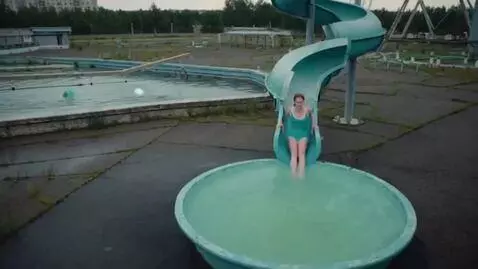
Cinematic, slow-burn tragicomedy sequence in the visual style of Andrei Zvyagintsev. A moody, overcast Russian summer afternoon at a dilapidated, retro-futuristic outdoor water park. A slender 25-year-old woman with auburn hair, wearing a vintage one-piece swimsuit, climbs the rusty ladder of a towering corkscrew slide. At the apex, she pauses, looking at the grey sky with a sudden, inexplicable premonition—a deep sigh before her inevitable descent. She plunges into the shallow pool below. The impact creates an implosion rather than an explosion of water. In a surreal display of altered physics, every drop of water in the park—from the wave pool to the children's splash pads—defies gravity and spirals into her body. She expands into a colossal, translucent, gelatinous sphere, her skin stretching into a glossy, rain-slicked membrane, refracting the cloudy sky. Inside, she glows with a soft, aquatic luminescence, her limbs pinned awkwardly against her massive form like a insect in amber. The final shot is a single, unbroken wide tracking shot down a wide, tree-lined Soviet-era boulevard (Khrushchev-era apartment blocks flanking the sides). The now-oversized woman, precisely the height of five adjacent houses, waddles awkwardly down the center of the empty street. Each step sends a delayed, seismic slosh through her immense body. Her face, albeit tiny relative to her bulk, is frozen in a mask of profound, scarlet-cheeked embarrassment. She clumsily knocks a streetlamp askew with her hip. Children on balconies point and giggle. She looks back at the camera (or the viewer) with a defeated, apologetic shrug, her entire watery form quivering gently with the motion, casting dancing ripples of light onto the facades of the buildings. Photorealistic textures, volumetric lighting, deep depth of field, 4k, 60fps, anamorphic lens.